
Example of Practice: Guide for Care Organizations
To create a multiweek program for participants in your organization, refer to the Art Modules. You have the option of sequencing multiple existing modules to create a multipart program that includes both art-looking and art-making components, or you can mix images from the Images section. If possible, you may incorporate trips to a museum into the program.
The following example features a four-part program at a care organization that includes both art-looking and art-making sessions. This program was conducted by a MoMA educator with a group of individuals with early-stage Alzheimer's disease.
The program was divided into separate art-looking and art-making, or studio, sessions. At the beginning of each studio session, the educator introduced reproductions of images from the previous art-looking session to incorporate the ideas discussed then into the art-making process. Although some participants who are in the early stages of the disease may be able to recall the artworks from the earlier discussion with little difficulty, it is always useful to reintroduce the images.
Part I: The Importance of Place
Theme
Choosing a broad theme for the first session is a good idea. Everyone can relate to "place"—feelings inspired by a place, loving a place filled with good memories, being moved by a specific scene in a specific place. By tapping into long-term memories, the educator thought she would get responses from a broader spectrum of the group.
Week I: Art-looking sessions
- Jacob August Riis. Bandits' Roost, 59 1/2 Mulberry Street. 1888
- Georges-Pierre Seurat. Port-en-Bessin, Entrance to the Harbor. 1888
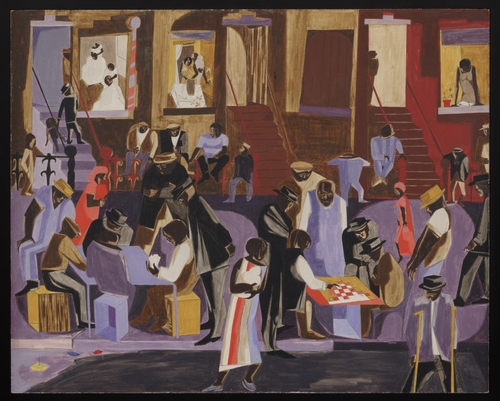
- Jacob Lawrence. Street Shadows. 1959
- Piet Mondrian. Broadway Boogie Woogie. 1942–43
The educator took several factors into consideration when choosing these works. First, she wanted to show a range of mediums and a range of techniques or artistic styles to encourage experimentation with materials during the studio session to follow. She was also concerned with appealing to a broad range of interests: she tried to include works that are representational and works that are abstract.
During the program, when she realized that she would not have the opportunity to get through all four works, she decided to use the works done by New York artists—she had started with Riis, and participants loved talking about the way things used to look in New York, as most of them were native New Yorkers. She thought Jacob Lawrence was a perfect complement for their discussion of the city.
During this session, the participants were very engaged and constantly asked questions and shared personal experiences—to the point that they spent almost thirty minutes discussing just the first work. Rather than rushing them along, the educator felt it would be more beneficial to get everyone to share as much as possible. She adjusted the number of works and the amount of time spent discussing each work to the group's interest.
Keep in mind the value and meaning of these types of connections. Rather than sticking to a plan without flexibility, it is much more fruitful to allow participants' responses and interests to direct the discussion. Digressions, sharing of personal experiences, storytelling, and reflections on life and art should be encouraged.
Week II: Studio session
The educator chose a watercolor project so the group could experiment with color and composition in a free-form way. Each participant spent an hour creating a piece inspired by a place that was special to him or her. The images discussed during Week I were shown again in Week II to provide reference to a variety of styles and places.
Overall response
The educator was very pleased with the outcome of the first two sessions. The participants had much to contribute, and while some were more verbal than others, everyone seemed engaged and stimulated. Some group members were a little disconcerted that they would have to make art, saying things like, "I'm not an artist," and, "You'll want to throw it away when I'm done," but everyone tried, and everyone—including a ninety-two-year-old woman who was very concerned because she had been an accountant and "not creative"—seemed pleased with their work. The educator considered the project a success the moment everyone had made a mark on their paper because this meant they had overcome their fear of doing something "right" and let their intuition take over.
Part II: The Power of a Portrait
Theme
The educator introduced this theme because it allowed for in-depth discussion of a topic that was easily accessible to all participants. She wanted to focus on artists' choices to generate a lively discussion about technique in order to inspire participants to experiment during the studio session.
Week III: Art-looking session
- Chuck Close. Self-Portrait. 1991
- Ernst Ludwig Kirchner. Street, Dresden. 1908
- Henri Matisse. The Red Studio.1911
- Pablo Picasso. Girl before a Mirror. 1932
The educator chose works that demonstrated a range of artistic styles and techniques. She started with Close, and the group marveled at the large scale of the work (about eight feet tall and seven feet wide) and at what they felt was the psychological state of the painter. The group was very interested in the artist's personal life and what caused him to paint the way he did. When looking at the work by Kirchner, participants brought up the idea of loneliness.
Also, the subject matter and time periods of the other paintings led the group to discuss feelings related to identity as well as the social and political context within which the works were made. This conversation also enabled some participants to access long-term memories, which led to very meaningful exchanges.
Week IV: Studio session
During the follow-up studio session, the group spent an hour working with self-hardening clay to create portraits that depicted themselves or someone else of their choosing. These could be done with any degree of realism and in any style they chose. The group worked with basic modeling tools, and the educator encouraged experimentation with materials. The project was sophisticated yet simple enough to complete in one session so that workshop participants felt a sense of accomplishment at the program's end. It was also very important to the educator that every week be filled with some activity that was different from what had come before it. She wanted the group to have a chance to "get messy," to work with various media, and to experiment with materials they had never tried before.
Overall response
The discussion was very productive, as participants made many connections to the works and to each other. The group was more comfortable this time when the educator presented the art-making activity.
Some were intimidated by the clay, and some were unwilling to get messy—but everyone tried to work with the material. The group's coordinator noted that the tactile materials seemed to bring many people out of their shells. She thought it might be nice to use clay again if there was time during a future session.
Some participants were very happy with their work and proud to take it home, while others were less impressed by their skills but welcomed the challenge and engagement during the workshops. Everyone reported having a very positive experience during the discussion and studio sessions. The educator remarked, "I do believe I learned more from them than they did from me in our time together!"

About Cultural Mediation
Cultural mediation can be understood through the lens of sociocultural theory, which emphasises that human thinking develops through social interaction and the use of cultural tools such as language, symbols, and artistic expression.
In the context of art and cultural mediation, these tools are not limited to words – they also include images, movement, storytelling, and shared experiences. Meaning is not created individually; it emerges through dialogue – between participants, artworks, and the mediator.
Rather than transmitting knowledge, the mediator creates conditions for reflection, interpretation, and connection. In this sense, cultural mediation supports processes similar to what has been described in research as internalisation – when shared experiences gradually become personal understanding.